In high-precision dispensing and high-speed production environments, selecting the right piezo jet valve directly impacts yield rate, process stability, and overall throughput. Why do so many manufacturers choose the MARCO piezo jet valve? What advantages does this type of piezo-driven dispensing technology offer?
This article outlines six key selection criteria and explains MARCO's system architecture philosophy, helping you understand the critical factors that truly influence dispensing performance and long-term production stability.
Table of Contents
- 1. Why Choose the MARCO Piezo Jet Valve?
- 2. Core Features of the MARCO Piezo Jet Valve
- 3. 6 Key Criteria for Selecting a MARCO Piezo Jet Valve
- 4. Why Does MARCO Emphasize a "Piezo Valve System" Architecture?
- 5. MARCO Piezo Jet Valve Implementation & Technical Support in Taiwan
- 6. 5 Recommended Pre-Production Process Evaluations
- 7. Brand Strength & After-Sales Support
- 8. Conclusion
Why Choose the MARCO Piezo Jet Valve?
MARCO (Germany) has long specialized in industrial automation and precision control technologies. In the field of precision dispensing, the brand has established a strong professional reputation.
Unlike equipment manufacturers that pursue broad product portfolios, MARCO concentrates its R&D resources on a single core technology—piezo jet valves—continuously optimizing stability, service life, and dispensing consistency.
In real-world applications, MARCO piezo jet valves are widely used in:
- Consumer electronics (3C) manufacturing
- SMT surface mount processes
- LED assembly
- Semiconductor packaging
Under long-term mass production conditions, MARCO has built a reputation among engineers as a solution that may not be the lowest cost option, but is one of the most reliable under high-speed production environments.
Core Features of the MARCO Piezo Jet Valve
The MARCO piezo jet valve is built around non-contact jet dispensing technology, making it particularly suitable for high-speed, high-consistency production lines.
Key advantages include:
- Fully piezo-driven actuation for fast response and high repeatability
- Compatibility with a wide range of dispensing applications and industries
- Modular design for easier maintenance and future system expansion
.png)
Marco mTV piezo jet valve supports high-frequency dispensing up to 1200 Hz with a fully piezo-driven structure.
In practice, overall dispensing performance depends not only on the valve itself, but also on whether it is integrated within the correct system architecture and production conditions.
6 Key Criteria for Selecting a MARCO Piezo Jet Valve
If you are considering a MARCO piezo jet valve, the following six criteria should guide your evaluation process.
1. Define Your Process Requirements First
Different dispensing processes demand very different performance characteristics.
Applications such as:
- Precision dot dispensing
- Continuous line dispensing
- Non-contact jetting
require distinct parameter configurations. Selection should begin with a clear understanding of actual process needs rather than specification comparison alone.
2. Analyze Adhesive Viscosity and Material Properties
Adhesive viscosity, filler content (particle size and concentration), and overall flow characteristics directly influence jetting stability. Low-viscosity and high-viscosity materials require significantly different jetting parameters and control strategies. Even when using the same piezo jet valve model, performance may vary depending on material behavior. In many cases, material characteristics are more decisive than industry category when determining valve suitability.
3. Evaluate Dispensing Accuracy and Consistency
One of the greatest advantages of piezo jet valve technology is highly consistent droplet control.
Stable dispensing volume contributes to:
- Higher yield rates
- Improved process repeatability
- Reduced variability in high-volume production
Even under high takt time conditions, the valve must maintain sufficient stability to ensure production performance is not compromised.
4. Consider Workpiece Constraints and Spatial Limitations
Real-world workpiece conditions are often more challenging than equipment specifications suggest.
Applications involving:
- Narrow spaces or deep cavities
- Uneven or fragile surfaces
- Special angles or 3D coating requirements
often benefit significantly from non-contact jet dispensing, which reduces mechanical stress and process risk.
5. Assess Production Capacity and Takt Time
High-speed production requirements directly affect valve configuration and system integration.
Key considerations include:
- Required dispensing frequency
- Multi-valve synchronization
- Compatibility with actual line takt time
Proper alignment between system capability and production speed is critical for long-term stability.
6. Evaluate Total Cost of Ownership (TCO)
Selection should not be based solely on equipment price. For production environments, long-term operational stability is often more important than initial investment.
Consider:
- Service life expectancy
- Maintenance and consumable costs
- Downtime risk and its impact on throughput
A stable system typically delivers greater long-term value.
Why Does MARCO Emphasize a "Piezo Valve System" Architecture?
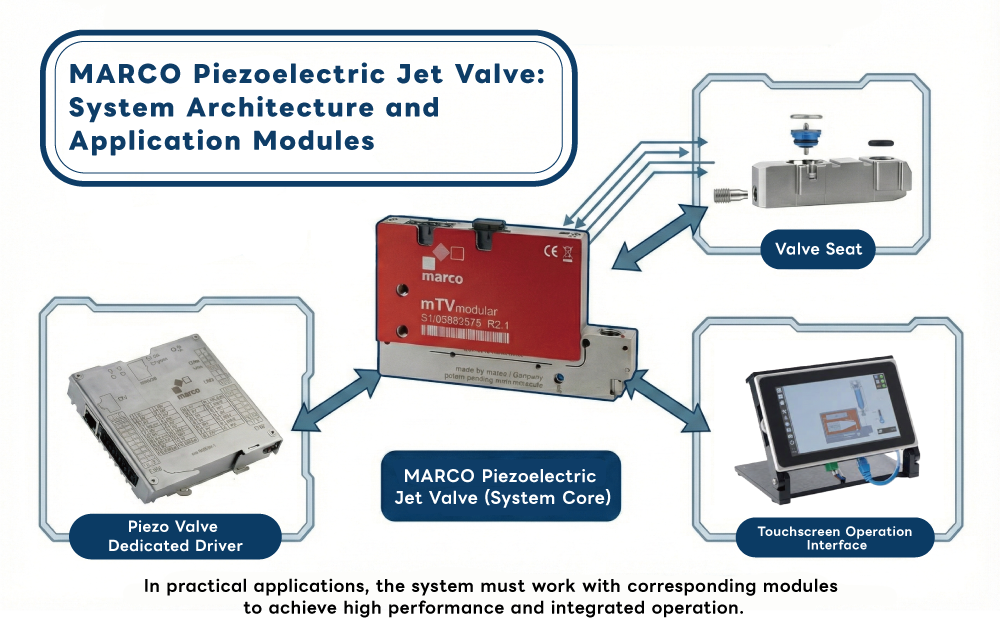
In MARCO's design philosophy, the piezo jet valve is only the core component of a complete dispensing system.
Effective implementation also requires:
- Dedicated piezo drivers
- Dispensing controllers and parameter configuration modules
- Touchscreen interface systems
- Multi-valve synchronization and system integration capability
These components are not standalone product lines. They are engineered to ensure the valve operates reliably under varying production conditions.
MARCO Piezo Jet Valve Implementation & Technical Support in Taiwan
Because the MARCO piezo jet valve is highly dependent on real production conditions, laboratory testing and process validation are typically required before full-scale implementation.
GATO Corporation, the official distributor of MARCO precision piezo jet valves in Taiwan, specializes in precision dispensing and automation applications.
Support includes:
- Piezo jet valve dispensing tests and feasibility validation
- Valve selection recommendations based on adhesive and process requirements
- Evaluation of production speed, takt time, and capacity planning
- Process optimization solutions for dispensing bottlenecks
Through early-stage testing and technical consultation, implementation risk can be significantly reduced, improving stability in high-speed production environments.
5 Recommended Pre-Production Process Evaluations
Because piezo jet valves are highly process-dependent precision systems, gathering key process information before implementation improves testing efficiency and system matching.
Typical evaluation areas include:
1. Adhesive type and material characteristics
Including viscosity range, filler presence, and sensitivity to temperature or shear force.
2. Dispensing process requirements
Dot, line, or non-contact jetting applications and required consistency levels.
3. Workpiece conditions
Geometry constraints, fragile components, deep cavities, or 3D coating requirements.
4. Production speed and mass production targets
Including defined takt time, throughput goals, and multi-valve configurations.
5. Implementation objectives
Current challenges such as instability, stringing, splashing, yield issues, or insufficient capacity.
Even if some parameters are not yet fully defined, structured testing and technical discussions can progressively complete the evaluation.
Brand Strength & After-Sales Support
MARCO's strength lies not only in valve performance, but in system-level engineering and long-term operational support.
Through collaboration with local distributors, after-sales services typically include:
- Process condition verification
- Parameter optimization recommendations
- Test result evaluation
- Production ramp-up support
For complex production environments, early testing and continuous technical discussion help reduce implementation risk and shorten system stabilization time.
Conclusion
Selecting a MARCO piezo jet valve is not a matter of comparing specifications alone. It requires a comprehensive evaluation of process requirements, system architecture, adhesive behavior, takt time, and long-term operational cost. Only by understanding these factors can manufacturers fully realize the value of piezo jet valve technology in high-speed production environments.
For complex applications, working with a distributor capable of laboratory testing and process validation is strongly recommended to ensure successful implementation.
Further Reading:
8 Key Questions Before Implementing the MARCO Piezo Jet Valve in Production
Diaphragm Valve Guide: How It Works, Top Applications & Maintenance Tips