Do you know what a dispensing valve is and how it works? In industries such as smartphones, automotive electronics, and precision manufacturing, dispensing is an essential production process. A dispensing valve acts like the heart of the dispensing system, directly affecting dispensing accuracy, process stability, and even the final product's quality and service life. In this guide, we will explain the working principles, applications, and common operating methods of dispensing valves so you can better evaluate and choose the right dispensing valve for your process.
Table of Contents
What Is a Dispensing Valve?
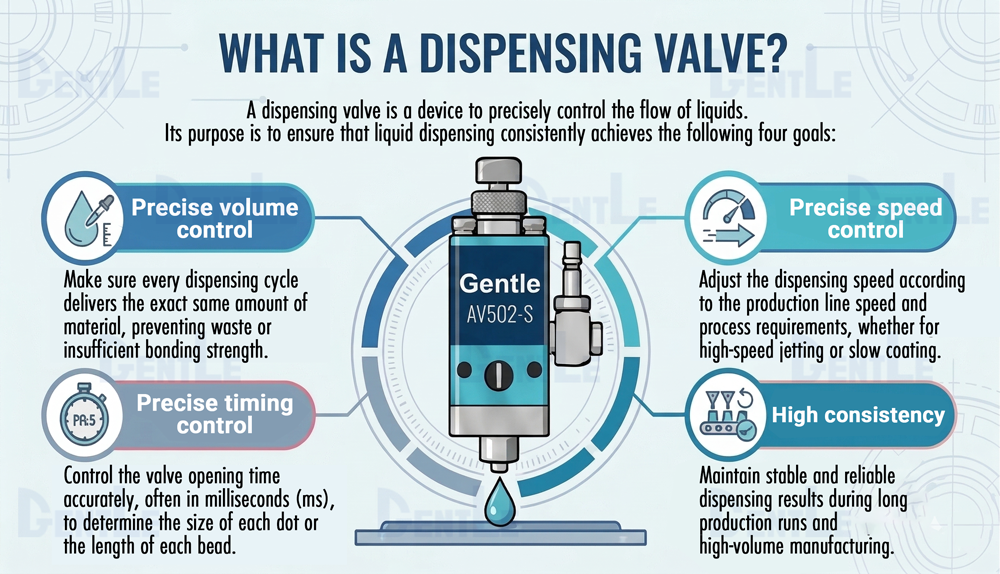
A dispensing valve is a device designed to precisely control the flow of liquids such as adhesives, grease, UV adhesive, solder paste, and silicone. Its purpose is to ensure that liquid dispensing consistently achieves the following four goals:
- Precise volume control: Make sure every dispensing cycle delivers the exact same amount of material, preventing waste or insufficient bonding strength.
- Precise speed control: Adjust the dispensing speed according to the production line speed and process requirements, whether for high-speed jetting or slow coating.
- Precise timing control: Control the valve opening time accurately, often in milliseconds (ms), to determine the size of each dot or the length of each bead.
- High consistency: Maintain stable and reliable dispensing results during long production runs and high-volume manufacturing.
A dispensing valve serves two important roles at the same time: it is both a high-speed precision switch for liquid flow and a fine flow control device. This makes it an essential working component in automatic dispensers, three-axis platforms, robotic arms, and many kinds of automation systems.
What Is a Dispensing Valve?
Dispensing Valve Principles and Uses
There are many types of dispensing valves on the market, ranging from simple pneumatic valves to advanced piezo-driven valves. While their internal structures differ, they all follow the same basic working principle, which can be divided into three key steps.
1. Upstream pressure feeding
First, the liquid material is loaded into a pressure source, such as a dispensing syringe, pressure tank, or a more advanced supply system. A stable source of compressed air or an electric pump applies continuous pressure to push the material toward the inlet of the dispensing valve.
2. Precise valve control
The internal mechanism of the dispensing valve, such as a needle, diaphragm, piston, or screw, is the core of the control system. When the controller, such as a PLC, sends a signal, the driving source, whether pneumatic or motor-driven, actuates the internal mechanism and opens or closes the valve instantly. The opening time, opening stroke, and internal structure together determine the dispensing volume for each cycle.
3. Precise metered dispensing
Driven by the upstream supply pressure, the liquid passes through the valve opening, which is controlled precisely in timing and size, and then exits steadily through a needle or nozzle.
Dispensing Valve Applications Across Industries
Dispensing valves are used in nearly every modern manufacturing industry that requires bonding, fixing, sealing, insulating, filling, or coating. Their core purpose is to place a precise amount of material in the right location at the right time.
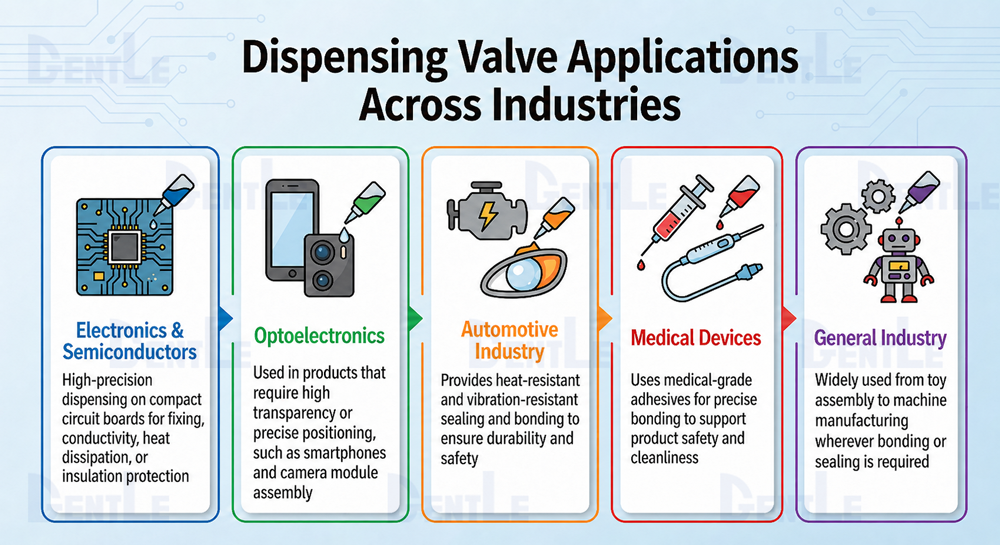
| Industry | Typical Applications | How They Are Used |
| Electronics and semiconductor | PCB component bonding, chip underfill, SMT red glue process, conductive silver paste application, semiconductor packaging | High-precision dispensing on compact circuit boards for fixing, conductivity, heat dissipation, or insulation protection |
| Optoelectronics | LED chip packaging, phosphor coating, optical lens positioning, mobile phone screen frame bonding | Used in products that require high transparency or precise positioning, such as smartphones and camera module assembly |
| Automotive industry | Automotive part sealing, lamp bonding, engine component coating, sensor potting | Provides heat-resistant and vibration-resistant sealing and bonding to ensure durability and safety |
| Medical devices | Medical catheter bonding, needle fixation, biomedical chip packaging | Uses medical-grade adhesives for precise bonding to support product safety and cleanliness |
| General industry | Screw locking adhesive, lubrication and fixing of mechanical parts, enclosure sealing | Widely used from toy assembly to machine manufacturing wherever bonding or sealing is required |
Dispensing Valve Applications Across Industries
Three Common Types of Dispensing Valves
Different material viscosities and process requirements call for completely different dispensing valve types. Below are three of the most common dispensing valve options and how they are typically used.
Pneumatic needle valve
A pneumatic needle valve, also known as a pin valve, uses air pressure to control the up-and-down movement of the needle for opening and closing. Its structure is simple, reliable, and widely used. The core principle is that compressed air pushes the internal needle or piston away from the valve seat, creating a path for the fluid to flow out. When the air pressure is removed, a spring pushes the needle back to close the passage. Because the tip of the needle is narrow and precise, it allows fine adjustment of the dispensing flow.
- Suitable materials: Medium- to low-viscosity materials with good flowability, such as UV adhesive, cyanoacrylate adhesive, alcohol, solvents, and epoxy
- Best for: General dispensing tasks that require reasonable precision but do not prioritize ultra-high speed, such as electronic component touch-up, localized coating, or lubricant application
Diaphragm valve
A diaphragm valve uses a flexible diaphragm, usually made of rubber or PTFE, to control opening and closing through elastic deformation. Since the fluid never contacts the internal metal components, this design helps prevent contamination and unwanted chemical reactions. The diaphragm completely isolates the fluid from the metal driving mechanism inside the valve. During dispensing, air pressure causes the diaphragm to bend upward and open the flow path. When closed, the diaphragm is pressed down tightly against the valve seat to block the fluid.
- Suitable materials: Ultra-low-viscosity, chemically reactive, or corrosive fluids such as cyanoacrylate adhesive, anaerobic adhesive, solvents, and flux
- Best for: Applications that require high cleanliness, prevention of material curing inside the valve, or high-speed dispensing of very small dots, such as medical device assembly and precision bonding of electronic components
Jet dispensing valve
A jet dispensing valve uses a non-contact dispensing principle. It can dispense at high speed from a certain working distance without moving the Z-axis down to touch the product surface. Instead of contacting the workpiece like a needle valve, the valve uses an internal piezo actuator or high-frequency solenoid to drive a tappet at extremely high frequency, sometimes hundreds or even thousands of times per second. This action impacts the valve seat and ejects the fluid as tiny droplets, much like the principle of an inkjet printer.
- Suitable materials: Medium- to low-viscosity materials such as chip encapsulation adhesive, UV adhesive, SMT red glue, and underfill material
- Best for: High-speed automated production lines, especially for products with uneven surfaces, fragile parts, or limited space, such as semiconductor packaging, SMT assembly, and smartphone camera module assembly
Conclusion
From the versatile pneumatic needle valve, to the diaphragm valve designed for special materials, to the ultra-fast jet dispensing valve, each dispensing valve type offers its own unique value. Choosing the right dispensing valve and using it correctly are key factors in improving production efficiency and product quality.
In summary, a dispensing valve is not just a component inside dispensing equipment. It is a core factor that directly affects process stability, dispensing consistency, and final product quality. From the basic operating principle and compatible materials to the practical use of different structures and control methods, every detail is closely related to dispensing precision and manufacturing efficiency. When selecting a dispensing valve, it is best to evaluate your product characteristics, process requirements, and automation level so you can choose the most suitable solution and improve overall production yield.
Further Reading:
What is a Liquid Dispensing Valve? A Complete Guide to Choosing the Best Brand & Specifications!
What is a Dispensing Machine? Easy Operation & Principles Explained!