Have you heard of pipe thread fittings? In precision components and pneumatic systems, pipe thread fittings are one of the most essential basic parts. They play a key role in keeping pneumatic systems stable, efficient, and leak-free. In this guide, we will explain the specifications, uses, and proper applications of pipe thread fittings so you can choose and use the right fitting correctly, reduce the risk of air leakage, and improve overall equipment performance.
Table of Contents
What Are Pipe Thread Fittings?
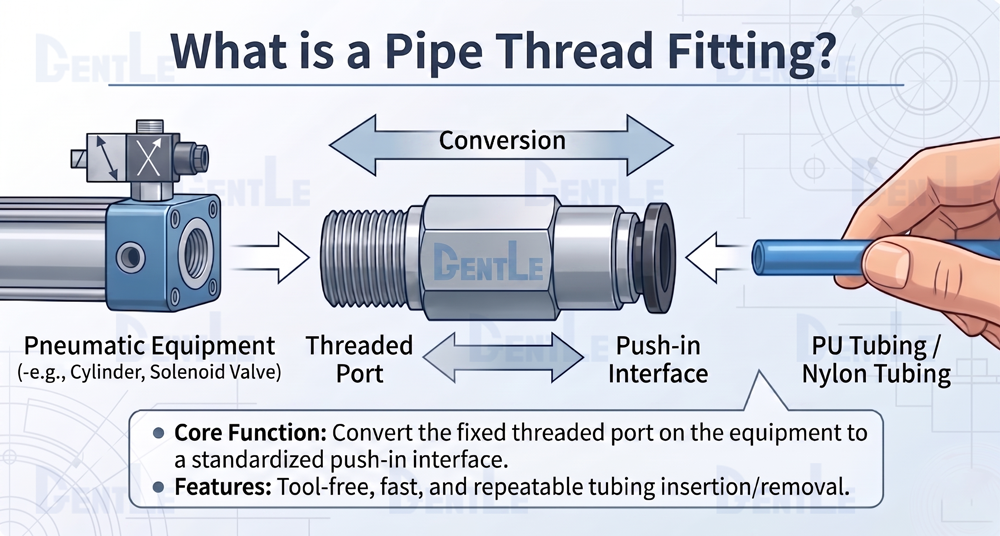
A pipe thread fitting is a type of pneumatic quick fitting with a threaded end on one side and a push-to-connect port on the other. Its main purpose is to convert the fixed threaded port on pneumatic equipment, such as the inlet and outlet ports of air cylinders or solenoid valves, into a standardized interface that allows users to connect or disconnect PU tubing or nylon tubing quickly, repeatedly, and by hand. This greatly improves installation efficiency.
- Threaded end
The threaded end is responsible for mechanical fastening and sealing with the equipment body. It is screwed into the female-threaded port of an air cylinder, valve body, or other pneumatic component to create a secure air supply connection.
- Push-to-connect end
The push-to-connect end is designed for connecting pneumatic tubing. Inside, it contains a precision collet and O-ring. When the tube is pushed in, the collet automatically locks onto the tubing, while the O-ring creates an airtight seal, making fast tool-free connection possible.
- Internal mechanical structure
- Collet (Gripper/Collet): Usually made of stainless steel, the collet has a ring-shaped structure with gripping teeth. It allows the tube to be inserted easily, but tightens when the tube is pulled outward, firmly gripping the tubing to prevent it from slipping out.
- O-ring: The main sealing component, typically made of NBR (nitrile rubber), which offers good oil resistance and wear resistance. Once the tube is inserted, the O-ring seals tightly against the outer diameter of the tube to prevent air leakage completely.
- Release ring: Pressing this plastic ring opens the collet and allows the tube to be removed easily, enabling quick disconnection.
Uses and Specifications of Pipe Thread Fittings
Pipe thread fittings are used in almost any environment where compressed air is involved. As one of the most common standard interfaces in pneumatic systems, they are widely used across many applications. Their main uses and specifications are explained below.
Use 1: Connecting actuators, such as air cylinders
The threaded end is screwed into the inlet or outlet port of the air cylinder, while the push-to-connect end connects the tubing. This allows compressed air from the valve to enter the cylinder and drive the piston in reciprocating motion. This is the most basic and direct application.
Use 2: Connecting control components
The air outlet ports of almost all pneumatic control valves are threaded. Pipe thread fittings are required to guide regulated or switched airflow to the next stage of the pneumatic system.
Use 3: Routing and branching pneumatic circuits
In complex equipment, air circuits often need to turn or branch. Different fitting shapes, such as elbow, tee, and Y-type fittings, help create an organized air line layout while saving space. They also reduce pressure loss and make the tubing arrangement cleaner and more professional.
Use 4: System maintenance and quick line change
The push-to-connect design allows maintenance personnel to disconnect or reconnect pneumatic tubing without tools. This greatly reduces downtime during machine repair, troubleshooting, or fixture and module replacement.
► Common Pipe Thread Types Compared
| Thread Type | Features | Notes |
| PT (RC) | A tapered thread that relies on thread taper and thread seal tape for sealing. It is the most common standard in pneumatic systems. | In Taiwan, PT and RC threads are often treated as the same. |
| NPT | An American tapered thread with a 60° thread angle, different from the 55° angle of PT threads. | Never mix NPT with PT. Forcing them together can damage the threads and cause leakage. |
| G (PF) | A straight parallel thread that seals with a gasket or O-ring at the end of the thread rather than through the thread itself. | Its sealing method is completely different and is often used in hydraulic systems or specific equipment ports. |
Four Common Ways to Use Pipe Thread Fittings
Pipe thread fittings come in a wide range of shapes and structural designs to meet different pneumatic tubing needs. Choosing the right type not only creates a more efficient tubing layout, but also helps prevent tubing damage caused by excessive bending. Below are four common types of pipe thread fittings and how they are used.
- Straight type (male straight push-in fitting)
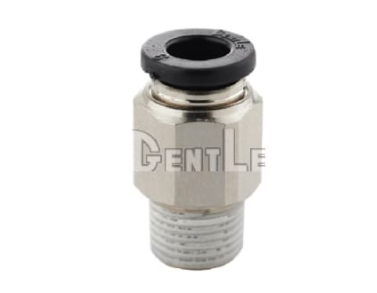
GENTLE_TS Straight Type Quick Fitting
- How it is used: Used to route tubing straight out from the equipment port for a direct connection. When no change in tubing direction is needed, the straight type is the first choice.
- Best for: Standard outlet configurations on all kinds of pneumatic equipment, such as air cylinders, filters, and valves.
- Example: Install a PT 1/4 × Φ8 straight fitting on the outlet port of a solenoid valve and connect it directly to the air inlet of an air cylinder.
- Elbow type (male elbow L fitting)
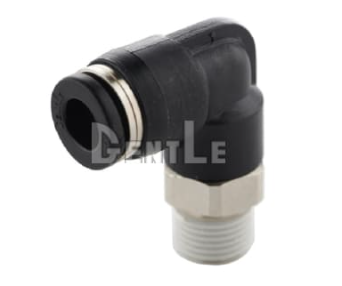
GENTLE_TL Elbow Type Quick Fitting
- How it is used: Used when installation space is limited or when the tubing needs to turn 90 degrees immediately. It allows the tube to change direction smoothly without creating severe kinking, which can seriously restrict airflow or even block the air line.
- Best for: Inside control boxes, at robotic arm joints, or in any space-constrained routing application.
- Advantages: Helps prevent tubing damage, maintains smooth airflow, creates a cleaner and more professional tubing layout, and greatly improves space efficiency.
- Tee type (threaded tee fitting)
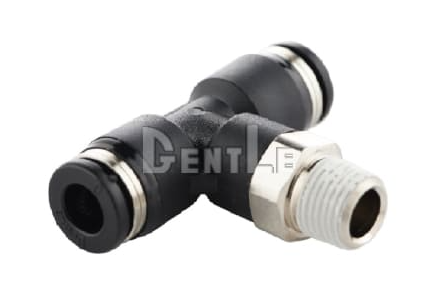
GENTLE_TT T Type Quick Fitting
- How it is used: Features one threaded end and two push-to-connect ports. Its main function is to split a single air source from the equipment side into two separate air lines.
- Best for: Applications where one valve port needs to drive two small air cylinders at the same time, or where a signal air source needs to branch off from the main air circuit.
- Example: Use a PT 1/4 × (Φ6 + Φ6) tee fitting to divide the output air source from one solenoid valve equally into two parallel Φ6 air tubes.
- Female-thread type (female straight push-in fitting)
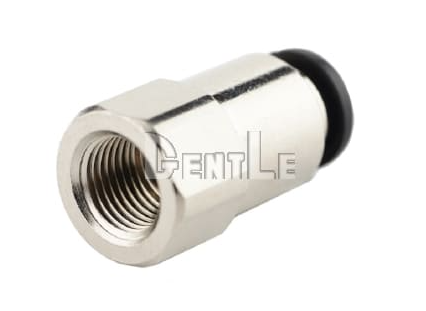
GENTLE_TSM Straight Type Female Quick Fitting
- How it is used: When the equipment body or the end of the pipeline has a male thread, a female-thread fitting is required for connection. Its threaded side has an internal thread designed to be fastened onto an external male thread.
- Best for: Connecting to ball valves, pressure gauges, or specially designed manifolds with male-threaded ports.
- Example: Install a 1/4 female thread × Φ8 push-in fitting onto the end of a pipeline with a 1/4 male thread to connect an 8 mm air tube.
Conclusion
Choosing the right pipe thread fitting depends on the actual tubing path and the available installation space. By using straight, elbow, tee, and female-thread fitting types flexibly, you can build a pneumatic system that is not only secure and reliable, but also clean and professionally arranged.
This design, which converts the threaded interface on equipment into a quick-connect tubing port, greatly improves installation and maintenance convenience while also directly affecting overall sealing performance and operating reliability. Finally, by fully understanding the differences in specifications, application scenarios, and correct usage methods, you can effectively reduce the risks of air leaks, pressure loss, and system failure, helping pneumatic equipment maintain long-term high-efficiency operation.
Further Reading:
Pneumatic Fitting Specifications and Types: How to Choose the Right One & Discover Its Benefits!
Choosing the Right Pneumatic Fitting: Nut, Push-In, or Barbed? Here's What You Need to Know